

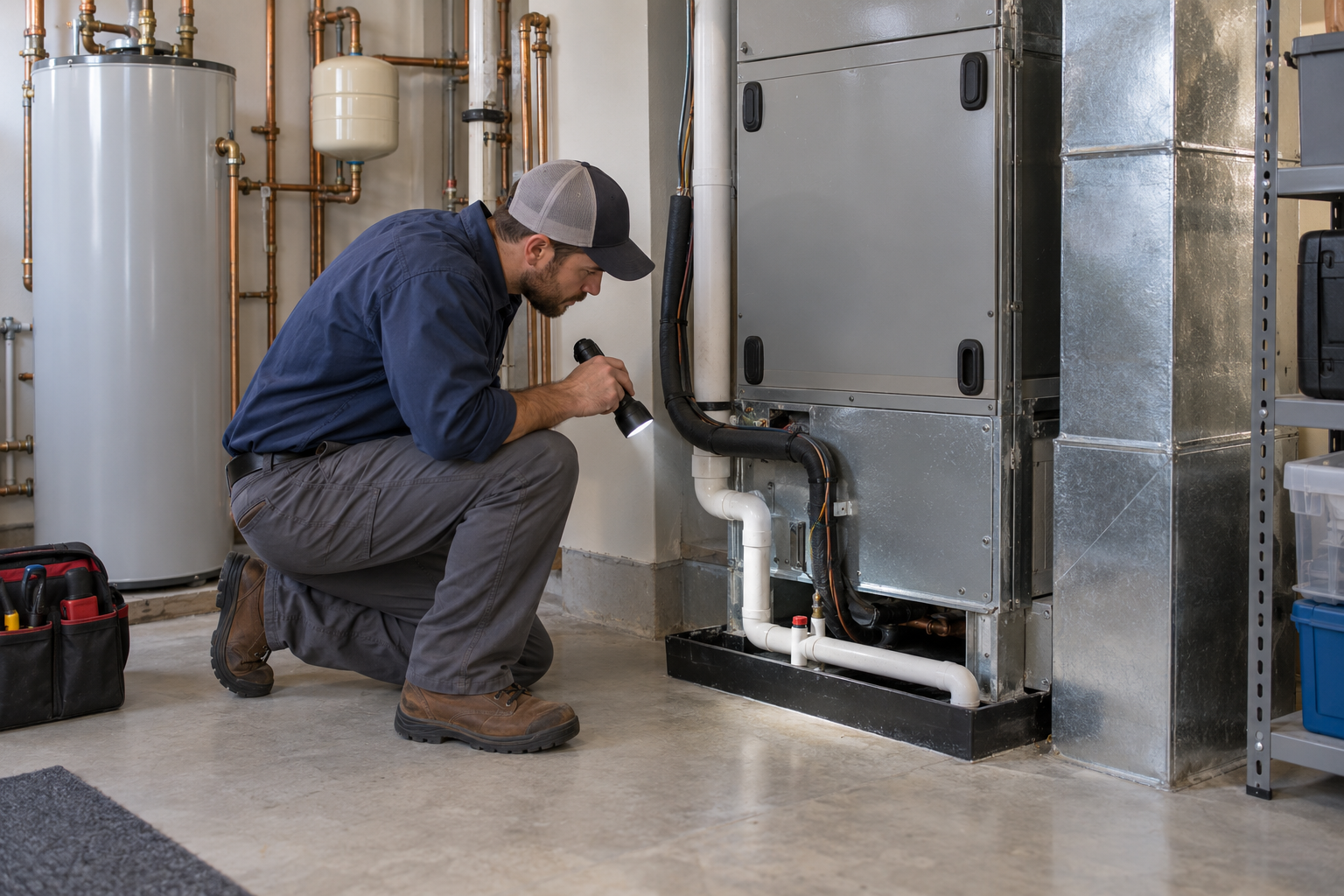
Finding water beside a furnace, air conditioner, or air handler raises an immediate question: should you call an HVAC technician or a plumber? The location of the puddle is a useful clue, but it does not establish the source. Mechanical rooms bring together equipment, water lines, drains, and sometimes appliances. A leak from one system can travel across the floor and make another system look responsible.
The best response combines safety, careful observations, and a clear handoff between the relevant trades. You do not need to diagnose a failed component before requesting service. You do need to explain what you can see, whether water is still escaping, and whether electricity or other hazards are involved. This guide helps organize that conversation and the repair sequence without encouraging hazardous troubleshooting.
Understand why different systems can look connected
Cooling equipment can produce condensate that must drain away as intended. Some heating equipment also has condensate arrangements, depending on its design. Meanwhile, nearby domestic plumbing carries pressurized water and wastewater, and other equipment may connect to one or both systems. A wet floor in this setting has several possible explanations, not one default diagnosis.
A condensate pipe, water supply line, floor drain, water heater, and washing machine may all be close together. Even when the systems are separate, a blocked route, loose connection, or leak elsewhere can create overlapping symptoms. Water might follow a sloped floor or an equipment platform before becoming visible. Treat the puddle as the starting point for investigation rather than proof that the closest machine has failed.
Look at the building's equipment records if they are available. Knowing the model and type of heating or cooling system can help the service provider prepare. Do not remove panels, reach into operating equipment, or disconnect pipes to identify a part. A photograph taken from a safe position and a simple description of the layout are usually enough for the initial call.
Decide whether the situation needs an emergency response
Water escaping continuously, rapidly spreading across the room, or affecting occupied areas deserves prompt attention. If the source appears to involve the building's water or drainage system, a 24/7 emergency plumber may be needed to control it. Confirm that the provider serves your location and explain that HVAC equipment is nearby, so the responders understand the setting.
Water around electrical components or wiring creates a separate safety concern. Stay out of standing water and do not touch wet equipment, switches, or cords. A strong gas odour, suspected combustion problem, or other immediate danger requires leaving the area and contacting the appropriate emergency service or utility. Do not treat every mechanical-room problem as a routine service appointment.
Where conditions are safe, describe the urgency accurately. Tell the provider whether the puddle is growing, whether a ceiling or wall below is affected, and whether the building can continue operating without the equipment. A rental or commercial property should also notify its responsible manager. These facts help prioritize the response more effectively than guessing which trade is at fault.
Gather observations without running diagnostic experiments
Record when you first saw water and whether the heating or cooling system had been running. Note recent laundry, shower, dishwasher, or other water use. Describe the weather and any recent maintenance. These details may reveal a pattern, but they should be presented as observations. Correlation with equipment operation is useful evidence, not a final diagnosis.
Photograph the overall room, the visible water path, and the nearby equipment from dry ground. If a display or model label is accessible without touching wet or energized parts, record it. Tell the service provider about any error message already visible. Avoid repeatedly restarting the system, deliberately using more water, or pouring liquid into a drain to see what happens.
A short timeline is particularly helpful when water appears intermittently. Write down the times of the observations and what was happening in the building. Keep those notes with earlier service records. The technician can decide which tests are appropriate; your role is to preserve the clues and make access straightforward without adding to the leak or creating another hazard.
What belongs in an HVAC inspection
An HVAC technician can evaluate the equipment and the components within the relevant service scope. Where condensate is involved, the inspection may consider the intended drainage route and associated equipment. The exact checks depend on the system's design and condition. A useful service explanation identifies what was inspected, what was found, and whether the water source was confirmed.
Ask the technician to distinguish an equipment-related leak from moisture arriving from elsewhere. If the inspection points to domestic plumbing, request a clear description to pass to the plumber. Photographs and a marked location can help avoid a second general search. If the source remains uncertain, ask which next inspection would narrow it down and why.
Do not assume that clearing one visible drain means the entire incident is resolved. The cause may involve a component, an installation detail, or another part of the building. Equally, do not assume that every nearby pipe falls within an HVAC service visit. Defining the scope at booking and documenting the findings makes the handoff more efficient.
What belongs in a plumbing inspection
A plumber assesses the relevant water supply and drainage systems. Depending on the symptoms, that may include nearby connections, appliances' plumbing interfaces, or drains receiving water from other equipment. Explain what the HVAC technician has already checked, but allow the plumber to make an independent assessment. A prior opinion is useful context, not a substitute for confirming the fault.
Ask which part of the system failed and how the repair will be tested. If an equipment connection must be disconnected or access is limited by heating and cooling components, clarify whether the two trades need to coordinate attendance. This is better resolved before work starts than after a plumber discovers that another specialist is needed to move or reconnect equipment.
Some properties have hydronic heating, boilers, or other systems in which the boundary between service scopes deserves particular care. Do not use a general description of a furnace leak to authorize work on an unfamiliar heating circuit. Give the provider the actual equipment information and ask which qualified professional should handle that specific system.
Coordinate the handoff instead of repeating the whole investigation
Appoint one point of contact for the incident, even if several trades are involved. Keep a shared record of the symptoms, inspections, findings, and planned next steps. In a home, this may simply be a folder of photographs and service notes. In a commercial building, a manager can circulate the relevant information to the responding contractors.
The handoff should answer practical questions. Has the source been identified? Is the leaking system isolated? Does equipment need to remain off? Is access work required? Who will confirm that the repair is complete? Clear answers reduce repeated attendance and prevent a contractor from assuming that another trade handled a necessary check.
Ask each provider to state the limits of their work. An HVAC repair may not include drying adjacent walls, and a plumbing repair may not include equipment assessment or floor reconstruction. Those omissions are not automatically a problem if the remaining work is assigned. They become a problem when everyone believes the incident is finished while a wet cavity or damaged surface has been overlooked.
Address the water damage around the equipment
Once source control is achieved, assess what the water reached. Nearby drywall, insulation, flooring, stored materials, or a platform can need attention even when the puddle itself is small. A restoration professional may be appropriate when damage extends into concealed spaces or the water's condition is uncertain. Avoid judging the whole incident only by the visible floor surface.
The EPA's moisture guidance supports addressing leaks promptly and correcting the water problem. If mold contamination of the HVAC system is suspected, seek professional guidance before operating it. The practical project question is who will evaluate affected materials and establish when cleanup, drying, and reconstruction are complete.
Keep equipment access available while this work is underway. Do not cover service panels or pack stored items against newly repaired components. Ask the HVAC technician and plumber for any operating restrictions that apply during drying or follow-on repairs. Restoration work and equipment operation should be coordinated rather than treated as unrelated activities in the same room.
Plan the return to normal operation
Before restarting equipment or restoring normal water use, follow the responsible provider's instructions. Confirm which repairs have been completed and which systems have been checked. If several trades worked on the incident, make sure the final handoff addresses both the equipment and the plumbing. A dry floor alone does not establish that every relevant component is ready.
Ask what to watch for during ordinary operation, including where to look and when to report a change. Keep the service notes accessible rather than relying on memory. If water reappears, record the new observation and contact the provider with the previous findings. Avoid a cycle of wiping up the puddle while repeatedly dismissing a recurring problem as normal condensation.
For commercial properties, record any operational change and make sure staff know whom to call. For homes, explain the plan to other occupants so nobody restarts equipment that is supposed to remain off. A short written instruction can prevent confusion after the responding technician has left, especially when work spans more than one day.
Reduce avoidable confusion at the next service visit
Maintain a simple equipment list with model information, prior service records, and clear identification of accessible controls. Keep the mechanical room organized enough for inspection and maintain the access required by the equipment and building. Ask qualified service providers about an appropriate maintenance plan rather than attempting unfamiliar drain or component modifications yourself.
Calgary HVAC's website lists heating, cooling, maintenance, and repair services. Its contact page is a starting point for discussing the HVAC side of a water incident. Share the timeline, equipment information, and any plumber's findings. A clear division of work helps resolve the water source, protect the surrounding room, and return the building's systems to service with fewer unanswered questions.
Easy steps to create a color palette
Lorem ipsum dolor sit amet, consectetur adipiscing elit lobortis arcu enim urna adipiscing praesent velit viverra sit semper lorem eu cursus vel hendrerit elementum morbi curabitur etiam nibh justo, lorem aliquet donec sed sit mi dignissim at ante massa mattis.
- Neque sodales ut etiam sit amet nisl purus non tellus orci ac auctor
- Adipiscing elit ut aliquam purus sit amet viverra suspendisse potent
- Mauris commodo quis imperdiet massa tincidunt nunc pulvinar
- Excepteur sint occaecat cupidatat non proident sunt in culpa qui officia
What is a color palette?
Vitae congue eu consequat ac felis placerat vestibulum lectus mauris ultrices cursus sit amet dictum sit amet justo donec enim diam porttitor lacus luctus accumsan tortor posuere praesent tristique magna sit amet purus gravida quis blandit turpis.

Don’t overspend on growth marketing without good retention rates
At risus viverra adipiscing at in tellus integer feugiat nisl pretium fusce id velit ut tortor sagittis orci a scelerisque purus semper eget at lectus urna duis convallis porta nibh venenatis cras sed felis eget neque laoreet suspendisse interdum consectetur libero id faucibus nisl donec pretium vulputate sapien nec sagittis aliquam nunc lobortis mattis aliquam faucibus purus in.
- Neque sodales ut etiam sit amet nisl purus non tellus orci ac auctor
- Adipiscing elit ut aliquam purus sit amet viverra suspendisse potenti
- Mauris commodo quis imperdiet massa tincidunt nunc pulvinar
- Adipiscing elit ut aliquam purus sit amet viverra suspendisse potenti
What’s the ideal customer retention rate?
Nisi quis eleifend quam adipiscing vitae aliquet bibendum enim facilisis gravida neque euismod in pellentesque massa placerat volutpat lacus laoreet non curabitur gravida odio aenean sed adipiscing diam donec adipiscing tristique risus amet est placerat in egestas erat.
“Lorem ipsum dolor sit amet consectetur adipiscing elit, sed do eiusmod tempor incididunt ut labore et dolore magna aliqua enim ad minim veniam.”
Next steps to increase your customer retention
Eget lorem dolor sed viverra ipsum nunc aliquet bibendum felis donec et odio pellentesque diam volutpat commodo sed egestas aliquam sem fringilla ut morbi tincidunt augue interdum velit euismod eu tincidunt tortor aliquam nulla facilisi aenean sed adipiscing diam donec adipiscing ut lectus arcu bibendum at varius vel pharetra nibh venenatis cras sed felis eget.


